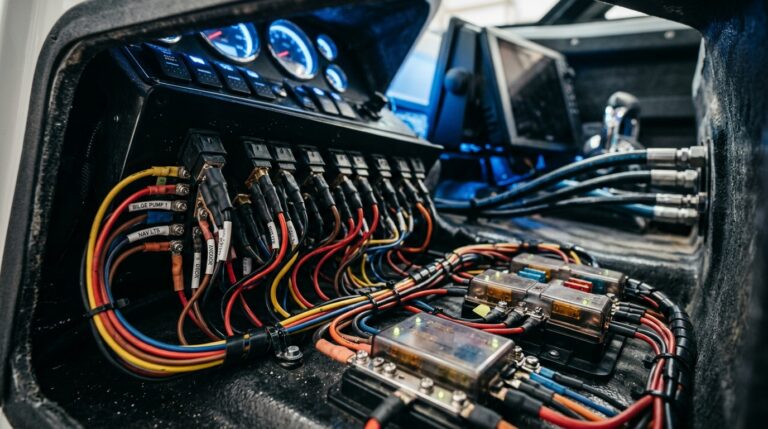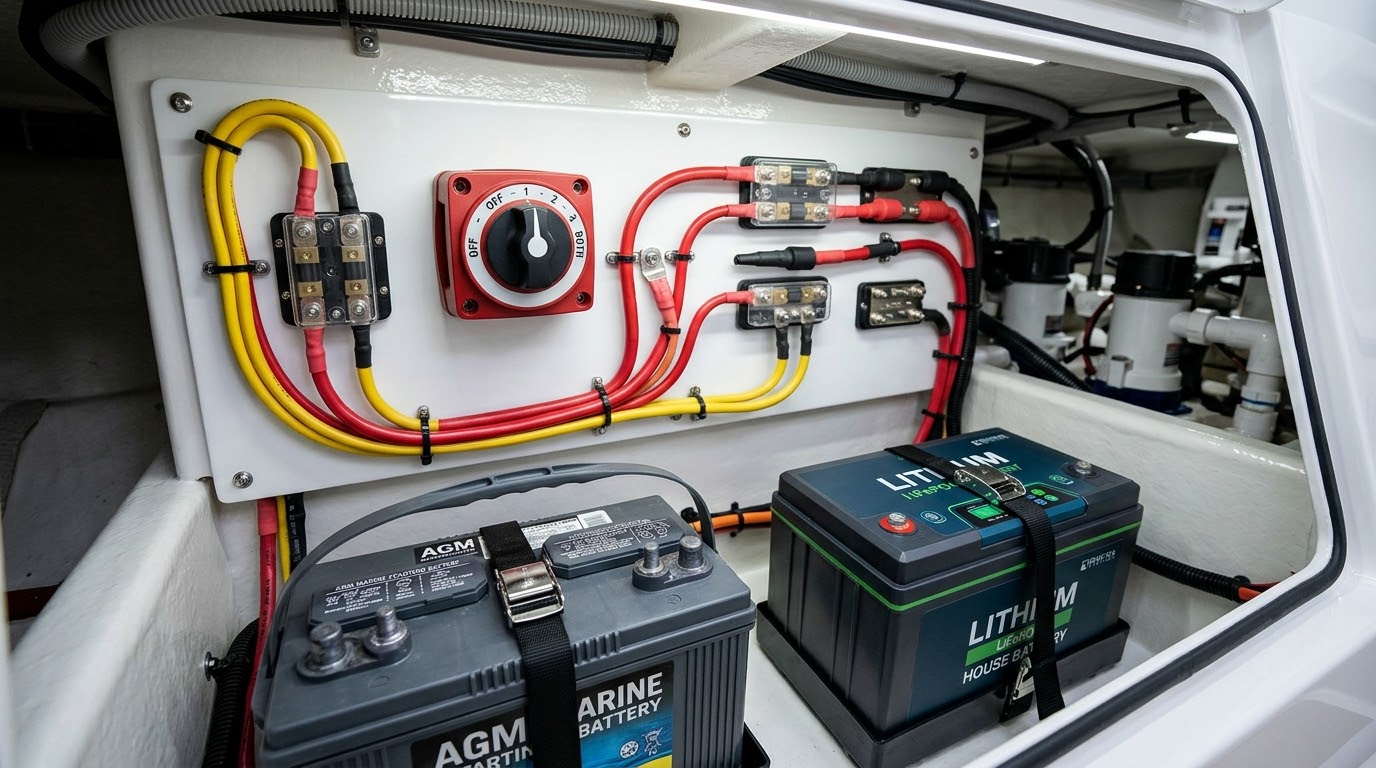
Configuring the optimal trolling motor battery setup is the secret to all-day tournament performance, precise GPS boat positioning (Spot-Lock), and effortless boat control in strong currents and windy conditions. A poorly planned battery bank leads to dead batteries before lunchtime, sluggish trolling motor thrust, blown circuit breakers, and heavy stern sag that hampers boat planing performance.
Whether you are rigging a 12V kayak motor, a 24V bass boat system, or a high-thrust 36V offshore center console motor from Minn Kota, Garmin, or Lowrance, selecting the correct trolling motor battery setup requires balancing battery chemistry, series wiring configurations, ampere-hour (Ah) reserve capacity, and multi-bank smart charging systems. Below, certified marine rigging technicians break down the ultimate battery architecture.

12V vs. 24V vs. 36V Trolling Motor Systems
Trolling motor thrust is directly proportional to operating voltage. Understanding the voltage demands of your motor dictates the complexity of your trolling motor battery setup:
| System Voltage | Thrust Range (lbs) | Recommended Boat Size | Required Battery Count (12V Units) |
|---|---|---|---|
| 12-Volt Single System | 45 to 55 lbs thrust | Kayaks, jon boats, skiffs under 16 feet | 1 x 12V Battery |
| 24-Volt Series System | 70 to 80 lbs thrust | Bass boats, bay boats 17 to 20 feet | 2 x 12V Batteries wired in series (or single 24V) |
| 36-Volt Series System | 100 to 112+ lbs thrust | Multi-species tournament rigs, offshore CC 21 to 30+ feet | 3 x 12V Batteries wired in series (or single 36V) |
Series Wiring Rule: To create a 24V or 36V system using standard 12V batteries, connect the positive (+) terminal of Battery 1 to the negative (-) terminal of Battery 2 using heavy tinned jumper cables. The remaining open positive and negative posts deliver 24V (or 36V across three batteries) to your trolling motor while maintaining the same ampere-hour capacity.
Battery Chemistry: Lithium Iron Phosphate (LiFePO4) vs. AGM
The biggest revolution in modern boating is the shift from heavy lead-acid/AGM batteries to Lithium Iron Phosphate (LiFePO4) for dedicated trolling motor banks:
| Feature / Metric | Deep-Cycle AGM Batteries (Group 31) | Lithium LiFePO4 Batteries (100Ah) | Performance Advantage |
|---|---|---|---|
| Total Weight (36V System) | 210 – 225 lbs (3 x 72 lbs) | 75 – 84 lbs (3 x 26 lbs) | Saves 140+ lbs off boat stern; faster hole shot and top speed |
| Usable Depth of Discharge | 50% max (50 usable Ah) | 100% usable (100 usable Ah) | Doubles your actual on-water trolling runtime |
| Voltage Discharge Curve | Voltage sags continuously under load (sluggish thrust by 2 PM) | Flat 12.8V – 13.0V output until completely empty | 100% full motor thrust all day long |
| Lifespan (Cycles) | 400 – 600 cycles (3-4 years) | 3,000 – 5,000+ cycles (10+ years) | Lowest cost-per-year over a decade of fishing |
Circuit Breaker & Wiring Safety (ABYC Compliance)
Modern brushless trolling motors can pull up to 50 to 60 amps at full speed in heavy chop. Safety standards published by the American Boat and Yacht Council (ABYC E-11) require a dedicated manual-reset thermal circuit breaker within 7 inches of the battery bank:
- Circuit Breaker Sizing: Install a marine-rated 50-amp or 60-amp waterproof manual reset circuit breaker (such as a Blue Sea Systems 187 Series) on the main positive conductor. This protects the wire from melting and acts as an emergency disconnect switch.
- Wire Gauge (AWG): Voltage drop kills trolling motor efficiency. For wire runs up to 15 feet from the bow to the battery compartment, use minimum 6 AWG tinned copper wire; for runs exceeding 20 feet, upgrade to 4 AWG wire.
- Quick-Disconnect Bow Plug: Install a heavy-duty marine trolling motor plug (such as a Marinco 70A or Battery Tender plug) at the bow instead of hardwiring. Disconnecting the plug prevents accidental motor activation while trailering.
Multi-Bank Smart Charging Guidelines
To keep your batteries healthy, install an on-board multi-bank microprocessor charger (such as a Minn Kota Precision or NOCO Genius GENPRO) capable of delivering 10 to 15 amps per bank. Ensure the charger features a dedicated Lithium profile that charges at 14.4V to 14.6V and turns off completely without entering high-voltage desulfation modes that trigger lithium internal BMS disconnects.
For additional electrical diagrams, review our foundational marine battery care guide, our marine dual battery switch wiring guide, and our marine electrical systems 101 guide.
Frequently Asked Questions About Trolling Motor Battery Setups
Can I connect my trolling motor batteries to my outboard motor starting battery?
No. Trolling motor battery banks must remain completely isolated from the engine starting battery. Trolling motors generate high electrical feedback and pulse-width modulation (PWM) interference that can damage delicate outboard ECM computers and cause severe sonar interference on fishfinders.
Do I need a special charger for marine lithium trolling motor batteries?
Yes. While AGM batteries require multi-stage float charging with temperature compensation, lithium LiFePO4 batteries require a constant-current / constant-voltage (CC/CV) profile without a continuous high-voltage float. Always select a marine charger with an explicit lithium mode.
How many amp-hours (Ah) do I need for a full day of fishing?
For most anglers fishing 6 to 8 hours in moderate wind and current, a 100Ah lithium battery setup (or 100Ah AGM bank) provides ample reserve power. If you frequently fish heavy offshore currents or rely heavily on GPS Spot-Lock anchoring in 25-knot winds, consider 125Ah or dual parallel lithium banks.
Can I charge my 24V or 36V trolling motor system with a single 12V charger?
You cannot charge a 24V or 36V system across the main terminals with a single 12V charger output. However, a multi-bank on-board charger features independent 12V lead pairs that connect to each individual battery in the series bank, charging all batteries simultaneously without disconnecting series jumper cables.
Published by Boat Maintenance Guide Electrical Systems Desk. Inspected in accordance with American Boat and Yacht Council (ABYC) E-11 standards and manufacturer rigging specifications.