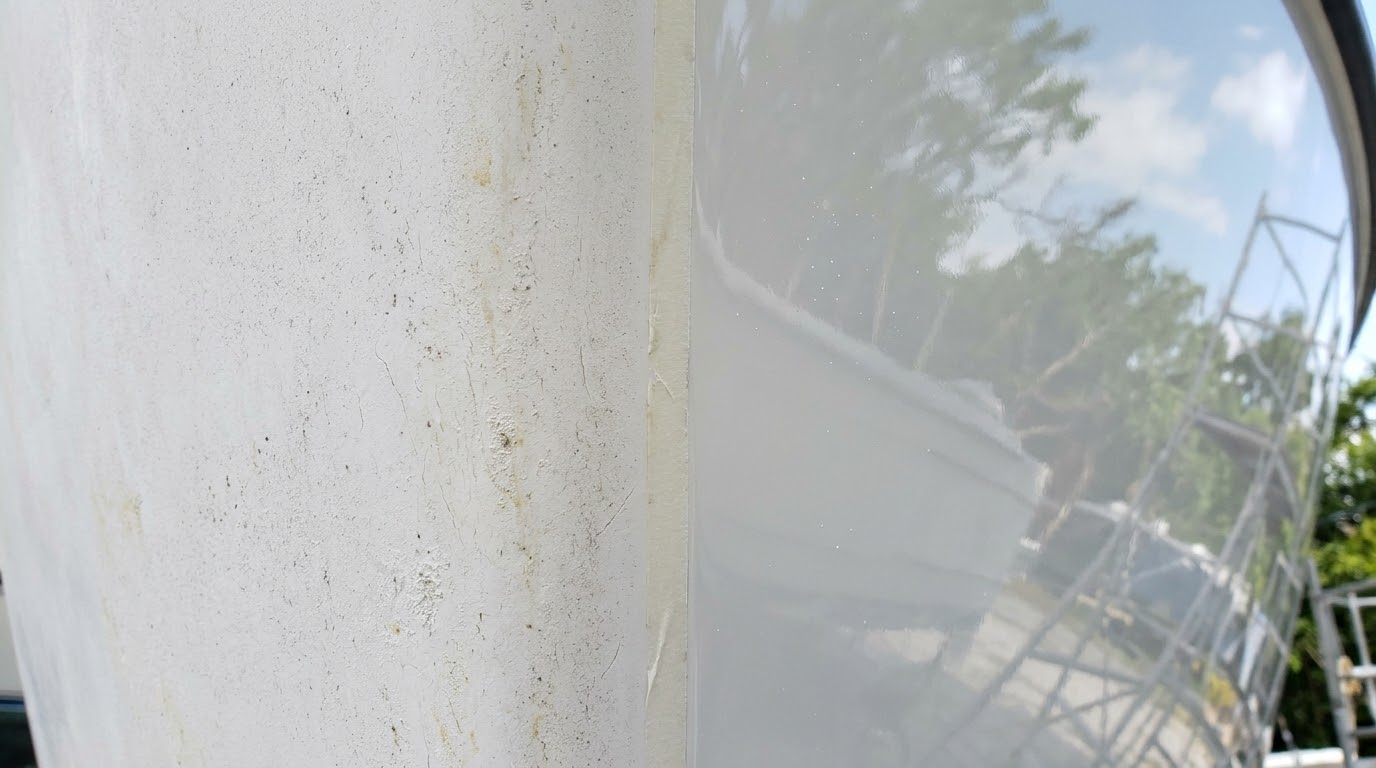
Nothing detracts from the pride of boat ownership quite like dull, chalky, sun-bleached fiberglass. While automotive finishes rely on ultra-thin polyurethane clear coats, fiberglass boats are sealed with thick, porous polyester gelcoat (typically 15 to 25 mils thick). Intense maritime ultraviolet (UV) radiation breaks down the polyester resin polymers, opening microscopic surface pores that trap dead pigment, salt crystals, and atmospheric grime.
The good news is that restoring oxidized boat gelcoat does not require an expensive $5,000 to $10,000 professional repainting job. Because gelcoat is remarkably thick, machine compounding physically abrades away the microscopic microscopic dead layer to expose fresh, unblemished resin beneath. Below, master yacht detailers walk you through the complete 4-stage compounding, polishing, and ceramic sealing protocol.
Determining the Severity of Gelcoat Oxidation
Before launching into your project for restoring oxidized boat gelcoat, diagnose the level of surface degradation to select the right abrasives:
| Oxidation Severity Tier | Visual & Tactile Symptoms | Required Mechanical Strategy | Pad & Machine Selection |
|---|---|---|---|
| Light Oxidation | Slight loss of gloss; surface feels smooth; no white chalk on hand | One-step marine cleaner wax or fine finishing glaze | Dual-Action (DA) orbital polisher with medium foam cutting pad |
| Moderate Oxidation | Noticeable dull haze; faint white chalk rubs off on fingertip; faded color | Medium-cut diminishing abrasive marine rubbing compound | Rotary buffer (1,400 RPM) with 50/50 wool-acrylic blend pad |
| Severe / Heavy Oxidation | Chalky white powder cakes on hand; rough sandpaper texture; faded decals | Wet sanding (1000/1500/2000 grit) + Heavy-cut marine compound | Rotary buffer (1,500 RPM) with 100% twisted 4-ply natural wool cutting pad |
Tool Selection: Why Rotary Buffers Trump Dual-Action Orbitals
The single biggest mistake amateur detailers make when restoring oxidized boat gelcoat is attempting to use an automotive Dual-Action (DA) random orbital polisher with a foam pad. While DA polishers are safe for paper-thin car clear coats, marine polyester gelcoat is hard and dense:
- Rotary Buffers (Direct Drive Power): Rotary machines (such as a Makita 9237C or DeWalt DWP849X) spin in a direct 1:1 circular drive. This mechanical action generates the controlled frictional heat (110°F to 130°F) required to soften polyester resin and level microscopic pores.
- 100% Twisted Wool Cutting Pads: Natural sheep wool fibers have microscopic natural barbs that cut aggressive compounds without flattening or clogging like foam pads. Foam absorbs compound inside its cells, generating excessive surface friction without cutting power. Always use twisted wool for the compounding step.
- Pad Spur Tool: Keep a steel pad spur tool on your belt. Every two sections, run the rotating wool pad against the spur to comb out dried compound caking and fluff the wool fibers.
The 4-Step Professional Gelcoat Restoration Protocol
Step 1: Thorough Decontamination Wash
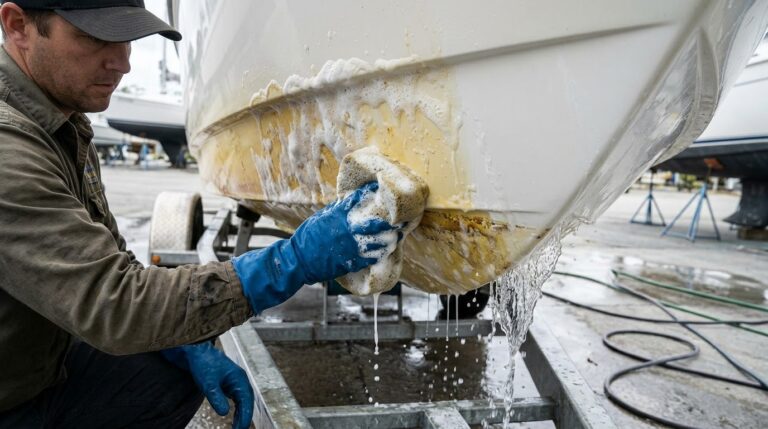
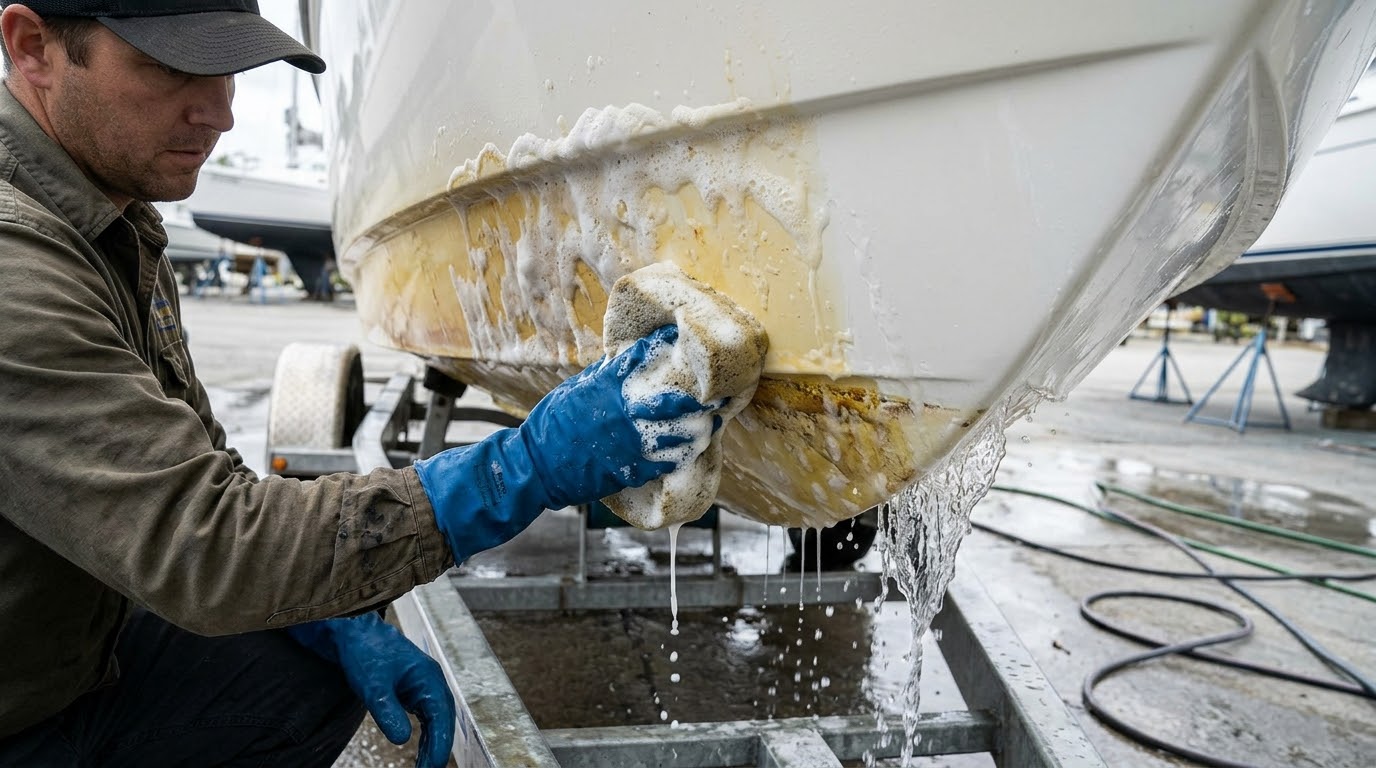
Never compound over dirty gelcoat! Gritty road dirt and lake scum dragged by a 1,500 RPM wool pad will scour deep swirl scratches into the hull. Wash the entire boat with high-sudsing marine wash to remove salt and dirt. If yellow waterline stains exist, dissolve them first using an oxalic acid cleaner following our guide to remove boat waterline stains. Wipe the dry gelcoat with isopropyl alcohol (IPA) to strip remaining silicones.
Step 2: Wet Sanding (For Heavy Oxidation Only)
If your gelcoat feels like chalky chalkboard slate, skip hours of compounding and wet sand first. Wrap 1,000-grit wet/dry sandpaper around a soft rubber sanding block. Spray the hull generously with soapy water. Sand in a uniform horizontal cross-hatch pattern with light pressure until the surface feels glass-smooth and milky white slurry flows off. Progress to 1,500-grit and 2,000-grit paper to refine the sanding scratches, then squeegee dry.
Step 3: Rotary Machine Compounding
Apply three quarter-sized dabs of heavy-cut diminishing abrasive marine compound (such as 3M Perfect-It Heavy Cutting Compound or Menzerna Marine Gelcoat Heavy Cut) onto your 100% twisted wool pad. Smear the compound across a 2×2-foot working square with the machine off. Set the rotary buffer to 1,200 to 1,500 RPM. Place the pad flat on the surface and pull the trigger, moving the buffer across the section in overlapping 50% horizontal and vertical passes using moderate downward pressure (roughly 10 lbs). Work the compound until it turns from a white paste to a clear, oily film, then buff off residue with a clean microfiber towel.
Step 4: Finishing Polish & Marine Ceramic Sealing
Switch your machine to a soft yellow foam finishing pad and apply a fine marine swirl remover polish (at 1,000 RPM) to eliminate wool holograms and rotary trails. Finally, protect your restored mirror finish immediately! Unsealed gelcoat will re-oxidize in direct sunlight within 60 days. Apply a multi-year marine SiO2 ceramic coating or a fluoropolymer synthetic sealant (such as Collinite 845 or Jescar Power Lock) to block UV rays for up to 12 months.
For deck detailing and teak maintenance, review our master marine hull and deck cleaning guide, and explore our master boat storage cost guide for protective storage bays.
Frequently Asked Questions About Restoring Oxidized Boat Gelcoat
Can you compound through the gelcoat down to fiberglass?
While possible on sharp body contour lines, reverse chines, or tight deck corners, burning through gelcoat on broad hull sides is extremely rare because factory gelcoat is remarkably thick (roughly 15 to 20 mils, compared to 2 mils of automotive paint). To avoid burn-through, reduce machine pressure and keep the rotary pad moving continuously over sharp hull edges.
Why did my boat gelcoat turn chalky again after just two months?
This happens when an owner compounds the gelcoat to a shine but applies cheap automotive carnauba wax instead of a true marine polymer sealant or ceramic coating. Carnauba wax has a low melting point (around 180°F in direct sunlight); hot maritime sun melts the wax off within weeks, exposing unsealed pores to rapid UV oxidation.
Is it better to hire a professional or do DIY gelcoat restoration?
For a 20-25ft boat, professional marine detailing shops charge between $800 and $1,800 for full wet-sanding and three-stage compounding. If you invest $250 in a quality rotary buffer, wool pads, and professional 3M compound, you can achieve identical show-quality results over a weekend while saving over $1,000.
What compound is best for dark colored (navy, black, burgundy) boat hulls?
Dark colored gelcoat reveals swirl marks easily. Use a high-lubricity compound that finishes clean (such as 3M Perfect-It Extra Cut or Starke Level-R), followed by a dedicated fine marine finishing polish on a soft black foam pad with an orbital machine to eliminate micro-holograms.
Published by Boat Maintenance Guide Detailers Desk. Inspected in accordance with American Boat and Yacht Council (ABYC) and EPA clean marina environmental preservation standards.